
שלח דוא"ל info@xinhuatextile.com
צריך עזרה כלשהי?+86 -13805995216
שלח דוא"ל info@xinhuatextile.com
צריך עזרה כלשהי?+86 -13805995216
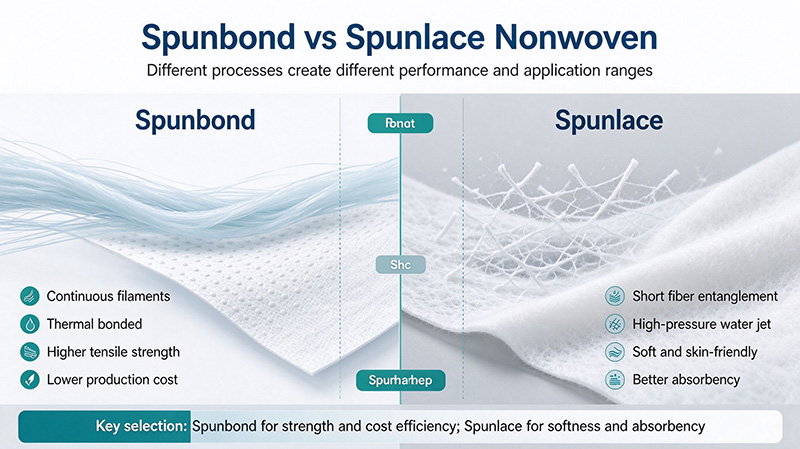
Spunbond and Spunlace are the two most prominent categories in the nonwoven fabric industry. While they may look similar, they differ significantly in terms of performance, cost, and suitable applications. Buyers often find it challenging to distinguish between the two; selecting the wrong material can lead to poor product texture, failure to meet functional requirements, and unnecessary procurement costs.
As a primary manufacturer of nonwoven fabrics, we break down the differences between these two materials across four key dimensions—manufacturing process, core performance, cost, and typical applications—and provide clear selection criteria to help you quickly identify the ideal nonwoven solution for your product.
I. The Essence of the Manufacturing Process: Fundamentally Different Production Principles
The performance gap between these two materials stems from the fact that their formation and consolidation methods are entirely distinct.
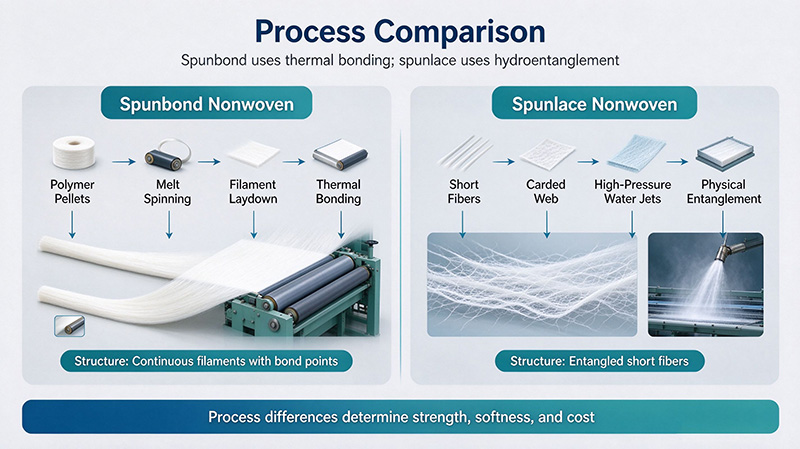
Spunbond nonwovens are produced via a melt-spinning process. Polymer chips (such as PP or PET) are melted and extruded through a spinneret to create continuous filaments. These filaments are then stretched by an airflow, laid out into a uniform web, and finally consolidated into a fabric through heat and pressure applied by thermal-bonding rollers.
- Key characteristics: Composed of continuous filaments, bonded via thermal-calendering (heat-pressed) points.
- High production efficiency—with line speeds reaching hundreds of meters per minute—offering a clear cost advantage.
- The fabric surface typically features visible bonding-point patterns, and the material tends to have a stiffer, crisper hand-feel.
Spunlace nonwovens are produced using a high-pressure hydro-entanglement process. Short fibers—such as viscose, polyester, or cotton—are first carded into a web. This web is then subjected to multiple high-pressure water jets from both sides, which cause the fibers to entangle and interlock, forming a cohesive fabric without the need for chemical binders or thermal-bonding points. - Key characteristic: Physical entanglement of short fibers; no chemical binders used.
- The fabric surface is fine and soft, with a tactile quality similar to traditional woven textiles.
- Production is more energy-intensive and involves a more complex process, resulting in a higher unit cost.
II. Comprehensive Performance Comparison
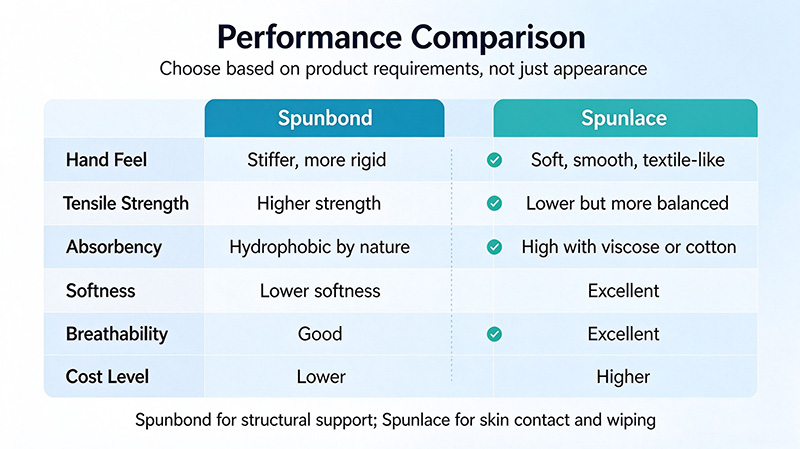
We have conducted a side-by-side comparison across 7 dimensions—the factors most critical to procurement—to help you quickly grasp the differences:
III. Typical Application Scenarios: Which Is Right for Your Product?
Choose Spunbond Nonwoven Fabric When...
The core advantages of spunbond nonwovens are **high strength, low cost, and resistance to water and moisture**. They are ideal for applications requiring protection, structural support, wrapping, or isolation:
1. Packaging & Industry: Nonwoven tote bags, shopping bags, product dust covers, and internal linings for furniture.
2. Agriculture & Horticulture: Weed-control fabric, crop covers for thermal insulation, seedling substrate fabric, and protective netting for fruit trees (against birds and insects).
3. Medical & Protective Outer Layers: Outer layers for disposable surgical gowns, protective coveralls, and face masks (the "S" layer in an SMS composite structure).
4. Home Furnishings & Substrates: Anti-slip backing for mattresses, internal linings for sofas, wallpaper substrates, and disposable bed sheets or tablecloths.
5. Geotechnical & Construction: Road-curing fabric, drainage/separation layers, and basic geotextiles.
A Simple Rule of Thumb: If the material will not be in direct, prolonged contact with skin, and your priorities are strength, cost-effectiveness, and resistance to water, moisture, or wear, choose spunbond. When to Prioritize Spunlace Nonwoven Fabrics
The core advantages of spunlace nonwoven fabrics are their softness, skin-friendliness, high absorbency, and resistance to shedding (lint-free). They are ideal for applications that involve direct contact with the skin and where the user experience is a priority:
1. Cleaning and Wiping: Wet wipes, cotton-based soft wipes, facial towels, makeup removal pads, and industrial lint-free cleaning cloths.
2. Beauty and Personal Care: Facial mask substrates, disposable facial towels, beauty bed sheets, and cosmetic cotton pads.
3. Medical and Hygienic Supplies: Medical dressings, substrates for adhesive bandages, disposable surgical drapes, and medical-grade wipes.
4. Mother and Baby Products: Baby wet/dry wipes, disposable bibs, and gentle skin-care wipes.
5. Premium Household Items: High-end disposable towels and hotel-use disposable face towels.
A simple rule of thumb: If the product comes into direct contact with the skin, requires a soft and skin-friendly feel, demands high absorbency and moisture retention, or prioritizes tactile comfort, choose spunlace.
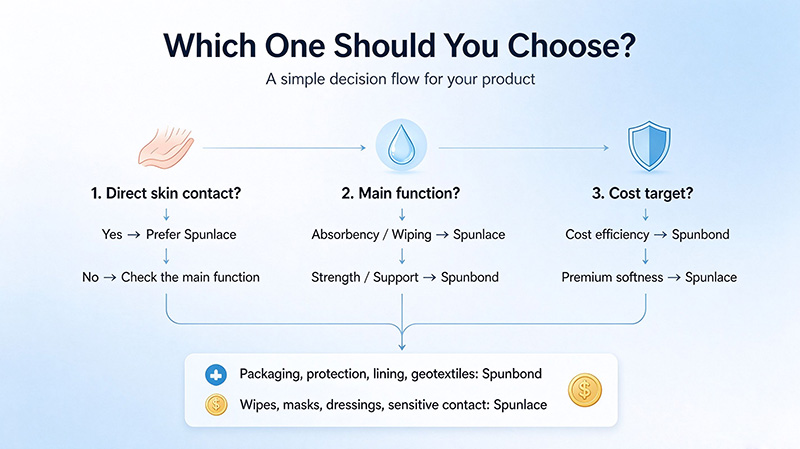
IV. Procurement and Selection: A 3-Step Quick Guide
If you are still undecided, follow these three steps to make a quick decision:
Step 1: Determine if there is direct contact with human skin.
- For direct contact with sensitive areas—such as the face, hands, or wounds—prioritize spunlace.
- For use as outer packaging, inner linings, base layers, or outer layers, prioritize spunbond.
Step 2: Identify the core functional requirements.
- If the primary needs are absorption, moisture retention, or wiping and cleaning, choose spunlace.
- If the primary needs are tensile strength, wear resistance, water resistance, or structural support, choose spunbond.
Step 3: Consider budget and product positioning.
- For cost-effective, high-volume applications where tactile feel is less critical, choose spunbond.
- For mid-to-high-end products where user experience is paramount and the unit price is higher, choose spunlace.
>
> Note: Many finished products combine both materials. For example, medical protective gowns may use spunbond for the outer layer to ensure strength, while using spunlace for the inner layer (against the skin) to enhance comfort. Similarly, facial masks often use spunlace as the substrate, while the outer packaging is made from spunbond. V. Our Material Advantages
As a primary manufacturer specializing in non-woven fabrics, we operate both spunbond and spunlace production lines, allowing us to provide tailored solutions based on your specific product requirements:
- Spunbond Series: Manufactured using 100% virgin polypropylene (PP) raw material, these fabrics offer consistent basis weight and stable tensile strength. They can be treated for specific functionalities—such as hydrophilicity, UV resistance, or flame retardancy—and are available in various patterns, including sesame-dot, circular-dot, and cross-hatch.
- Spunlace Series: Featuring customizable blends of viscose and polyester, these fabrics offer a smooth, lint-free surface. Available in textures such as plain, pearl-embossed, or mesh, they meet safety standards for skin-contact applications.
- Customization: Basis weight, width, color, and functional properties can all be customized to your specifications. We provide relevant test reports and samples for evaluation.
- Quality Assurance: Every batch undergoes rigorous testing for basis weight, tensile strength, and uniformity. We use only virgin raw materials, strictly avoiding the use of recycled materials or inferior substitutes.
If you are unsure whether your product requires spunbond or spunlace fabric, or if you need a quote and samples for specific technical requirements, please feel free to contact us. We will recommend the most suitable non-woven solution based on your intended application, performance needs, and budget.
FAQ
Q1: For the same basis weight (grammage), which is stronger and more durable: spunbond or spunlace?
A: At the same basis weight, spunbond nonwoven fabric has a higher absolute tensile strength due to its continuous filament structure. Spunlace, which consists of entangled short fibers, has slightly lower strength but offers more uniform properties in both the machine and cross directions. If your product requires high tensile strength, wear resistance, or load-bearing capacity, choose spunbond; if softness and skin-friendliness are the priorities, choose spunlace.
Q2: Can spunbond nonwovens be made absorbent? Is spunlace the only option for absorbency?
A: While virgin PP (polypropylene) spunbond is inherently hydrophobic, it can be treated with a hydrophilic finish to become absorbent—a common feature in disposable bed sheets and the outer layers of medical dressings. Spunlace, on the other hand, can incorporate fibers like viscose or cotton to achieve superior water absorption and retention, making it ideal for products such as wet wipes and facial towels.
Q3: Can spunbond and spunlace nonwovens be washed and reused?
A: Both are classified as disposable nonwoven materials and are not recommended for repeated washing. Washing causes spunbond to deform and lose strength, while spunlace tends to pill and experience fiber loosening. If reusability is required, consider using thicker needle-punched nonwovens or woven fabrics instead.
Q4: Why is spunlace generally more expensive than spunbond, and what is the typical price difference?
A: Spunlace production is more energy-intensive, involves more complex raw material blends, and utilizes short-fiber raw materials that are costlier than standard PP chips. For the same basis weight, standard spunlace is typically 1.5 to 2.5 times the price of standard spunbond. Spunlace containing high proportions of materials like viscose or Tencel will be even more expensive.
Q5: If I don’t have testing equipment, how can I distinguish between spunbond and spunlace by eye?
A: Look at the fabric surface: Spunbond features distinct thermal-bonded patterns (such as small dots or "sesame seed" patterns) and has a relatively stiff feel. Spunlace, by contrast, has a smooth, uniform surface without any bonding patterns and feels soft to the touch. 2. Edge/Pull-apart Characteristics: When pulled apart, spunbond nonwovens consist of continuous filaments, whereas hydroentangled (spunlace) nonwovens consist of loose, short fibers.
Q6: Can spunbond be used instead of hydroentangled (spunlace) nonwovens in medical and hygiene products to reduce costs?
A: For outer protective layers, isolation barriers, or packaging components, it is possible to switch to spunbond or SMS composite fabrics. However, for items that come into direct contact with the skin or wounds—such as wipes or dressings—such a substitution is not recommended. Doing so could lead to issues like poor skin-friendliness, fiber shedding, or insufficient absorbency, which would negatively affect both the user experience and regulatory compliance.
המשיכו לקרוא, הישארו מעודכנים, הירשמו, ונשמח שתספרו לנו מה אתם חושבים.
זכויות יוצרים
@ 2026 חברת טקסטיל שינחואה בע"מ כל הזכויות שמורות
. רשת נתמכת
Hi! Click one of our members below to chat on
 עִברִית
 English
 Français
 Deutsch
 Русский
 Italiano
 Español
 Português
 عربي
 Indonesia